Air cooler or fan: what each one actually does
Both sit on the same shelf and do different jobs. One moves air, the other takes heat out of it — and the second has a condition of use people usually discover too late.
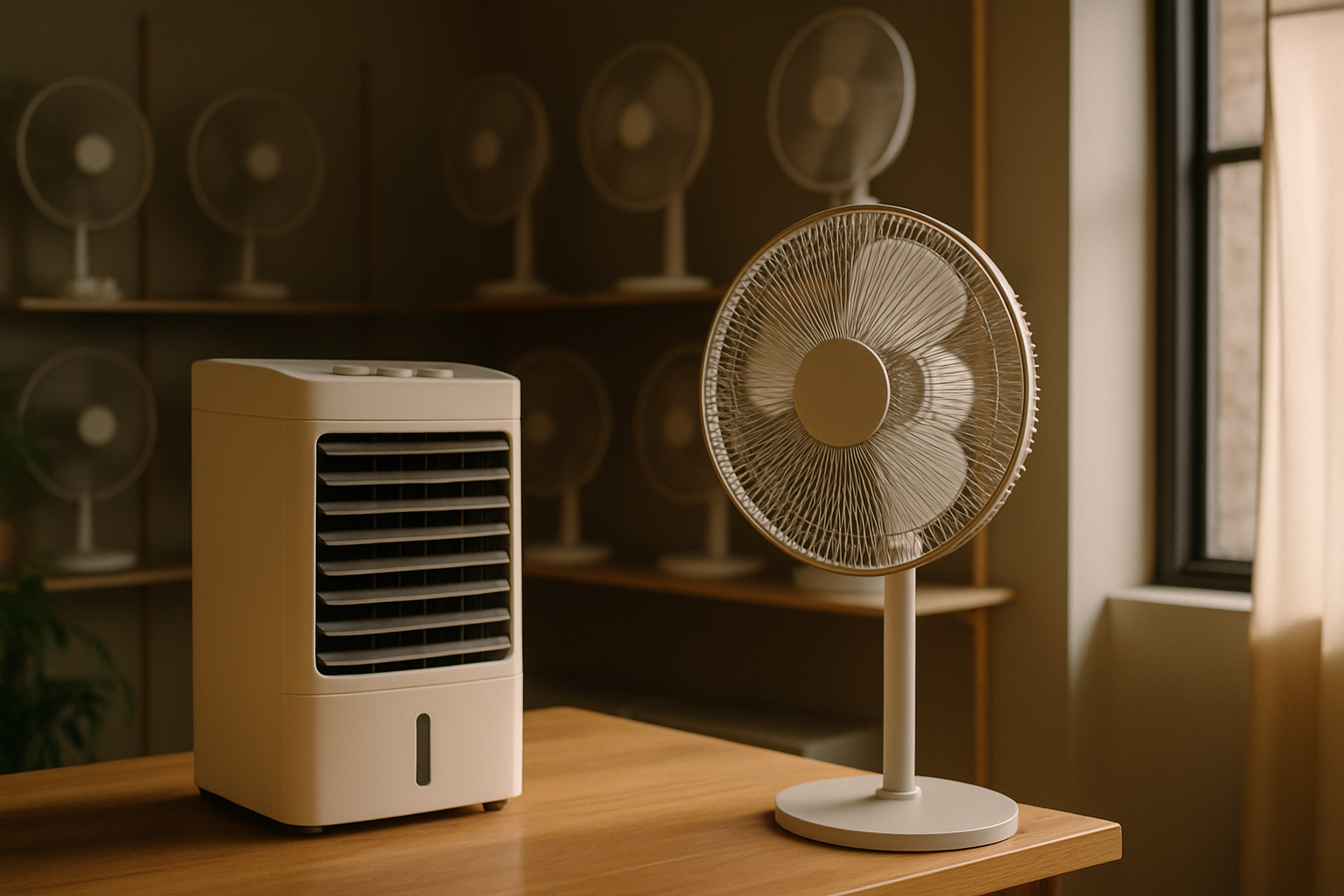
In three lines
A fan does not bring a room's temperature down. It creates a draught, and moving air speeds up the evaporation of sweat: it is your skin that cools, not the room.
A water cooler genuinely lowers the temperature of the air it puts out, by two to four degrees, by evaporating water through a filter.
That evaporation needs dry air. In a closed room humidity rises and the effect dies within an hour: you have to leave a window ajar.
In the shop: USB air cooler — mist and seven colours and Water air cooler — for one room, not a corridor.
Why a fan cools nothing
The experiment is easy to run at home: put a thermometer in a room, switch a fan on, wait twenty minutes. The needle does not move. It even creeps up very slightly, because the motor dumps its own heat into the room.
What you feel is real all the same. Skin sheds heat by evaporation, and a still film of air clinging to the skin slows that evaporation down. The fan sweeps that film away: evaporation restarts, and the sensation gains three to four degrees.
The practical consequence is direct: a fan running in an empty room is useless. It only cools what sits in its stream. That is also what makes it frugal — around thirty watts against eight hundred to a thousand for a portable air conditioner.
What a water cooler does, and on what condition
The principle is called evaporative cooling, and it is as old as porous water jars. Incoming air passes through a water-soaked filter. To go from liquid to vapour, water needs energy, and it takes that energy from the air passing through. The air comes out colder and damper.
The measured gain at the outlet is around three degrees in ordinary conditions, more if the air is very dry. Over a modest volume — a bedroom, an office, a corner of a living room — it is unambiguously noticeable.
The trade-off is written into the principle: the humidity released stays in the room. If nothing carries it away, the air saturates, evaporation slows, and the cooler ends up producing nothing but lukewarm wind. A window ajar is enough, and it is counter-intuitive enough that many disappointed buyers never tried it.
A second consequence of the same mechanism: in an already humid region, by the sea or in a tropical climate, the gain is small from the start. That is not a fault in the device, it is physics.
What neither of them replaces
Neither is air conditioning. Air conditioning extracts heat from a volume and dumps it elsewhere — which is why it needs a duct to the outside or a unit on the wall. A cooler dumps nothing: it turns sensible heat into humidity, indoors.
In a poorly insulated top-floor flat, neither will fix the underlying problem, which is heat coming in through the roof. A shutter closed on the sunny side and night-time ventilation often win more degrees than any appliance.
And for one person sitting at a desk, the cheapest answer is still to cool the body rather than the room: a neck ring or a small wearable fan costs fifteen to thirty euros and follows the person from room to room.
Choose by situation, not by spec sheet
Dry room, top floor, a window that opens: the cooler gives the best result per euro spent, and it requires neither building work nor a freeholder's agreement.
Desk, bed, sofa — a single occupied spot: a fan is plenty, it draws three times less, and aiming it well matters more than its power rating.
Humid climate or a room that cannot be aired: neither will keep the promise. Better to spend the budget on blocking the windows and on wearable cooling.
One last criterion decides more purchases than people admit: noise. A two-speed device whose lower speed is already loud will never be used at night, whatever its stated performance.
Frequently asked questions
Does an air cooler really lower the temperature?
Yes, but the temperature of the air it puts out, not of the whole room. Expect two to four degrees at the outlet, provided the ambient air is dry and a window stays ajar.
Why do you have to open a window with an air cooler?
Because it cools by evaporating water, and that water stays in the room as vapour. Without air renewal the humidity saturates the atmosphere and evaporation — so cooling — stops.
Does a fan use much electricity?
Very little: fifteen to fifty watts depending on model and speed. That is twenty times less than a portable air conditioner, which runs at around eight hundred to a thousand watts.
Can you use a cooler in a bedroom at night?
Technically yes, but two things decide: the noise at the lowest speed, and the humidity that builds up in a closed room. A window left ajar fixes the second point and not the first.
Should you put ice in the tank?
It improves the result for the first twenty to thirty minutes, then the effect fades as the ice melts. It is an occasional boost, not a way of running the machine.
Is a cooler suitable by the sea?
Not really. The air there already carries humidity, and evaporation — so cooling — is weak from the start. In that case a well-aimed fan does better for less money.
What area can an air cooler handle?
Portable models act on a few square metres around them, not on a whole room. Treating them as close-range devices avoids disappointment.
Does the filter need cleaning, and how often?
Yes, otherwise it clogs and the water circulates badly. A rinse every two to three weeks in daily use, and a full dry-out before storing at the end of the season.