Cool your neck, not the room: why it works
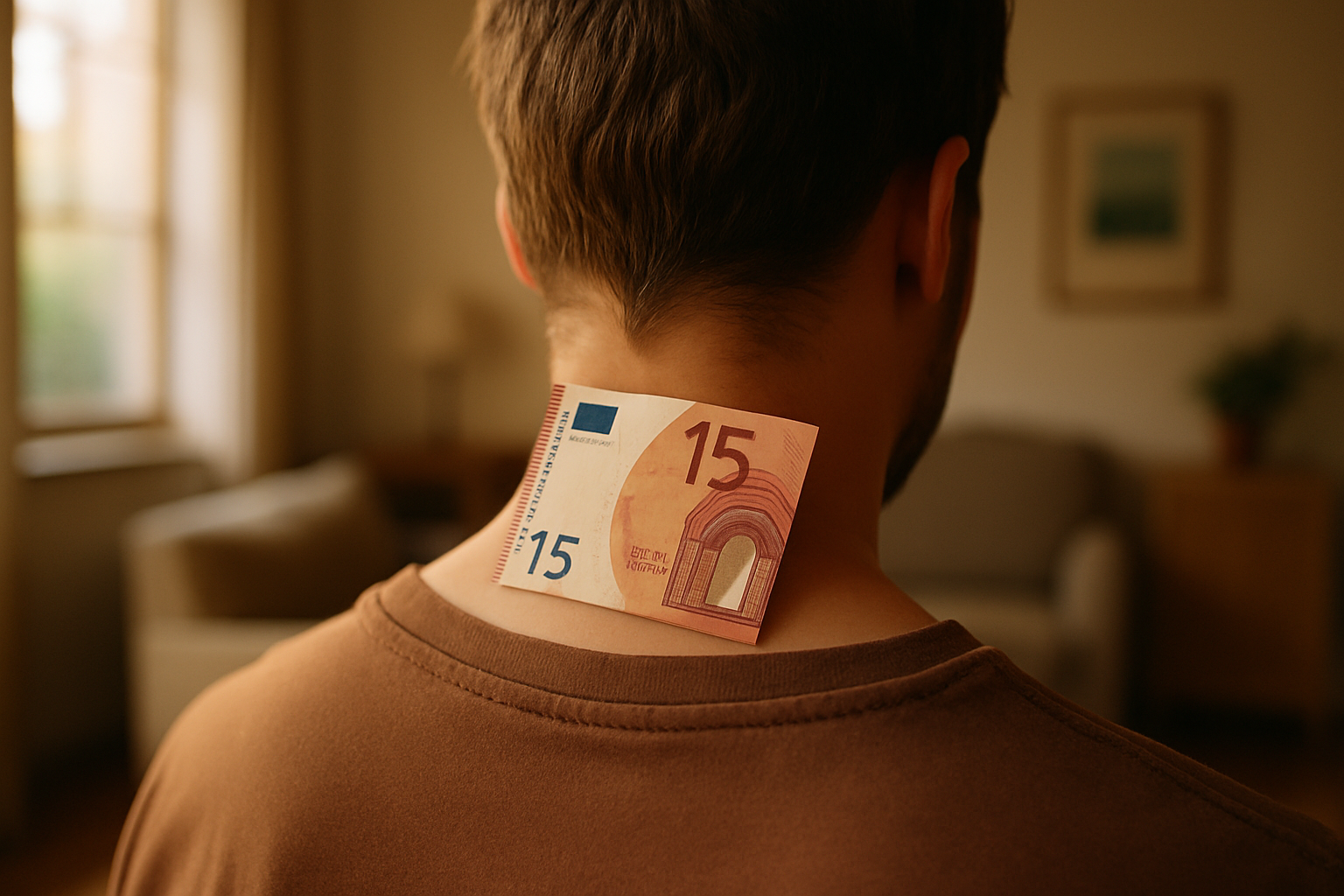
Fifteen euros around your neck change how you feel more than three hundred euros in the middle of the living room. It is not a trick: it is blood flow, and it can be measured.
In three lines
Blood runs close to the skin at the neck, the wrists and the temples. Cooling it there cools the whole body, fast.
Three families of objects do this, and they do not serve the same moment: wearable fans, gel rings, evaporative towels.
The deciding criterion is not price but the duration you are aiming at — an hour, a day, an effort.
In the shop: Instant sports towel — with its case and Cooling towel — wet, wring, snap.
Why the neck and not the back
The human body sheds heat through the skin, but not uniformly. There are zones where large vessels run at shallow depth: the neck, the inner wrists, the groin, the temples. Blood passing there cools on contact, then travels back to the rest of the body.
That is why first responders cool those zones first on a heatstroke casualty. The same mechanism, at an infinitely smaller intensity, explains why a fifteen-euro ring on the neck beats a living-room fan two metres away.
There is also a plain physics reason: energy spent. Cooling twenty-five cubic metres of air takes hundreds of watts. Cooling a ten-centimetre band of skin takes a handful, or none at all in the case of a gel.
The three families, and what they do not do
Wearable fans — neck, waist, clip — blow continuously as long as the battery lasts, generally four to eight hours depending on speed. Their strength is that they do not run out the way a gel does; their weakness is noise, always underestimated at purchase, and the fact that they cool nothing if there is no sweat to evaporate.
Gel rings and caps take heat by direct contact, one to two hours depending on their starting temperature, then have to go back to the freezer or into cold water. They hold a decisive advantage in some contexts: they make no noise and need no battery.
Dense-weave towels work by evaporation. Soaked, wrung out and snapped, they drop clearly below ambient temperature and hold as long as they stay damp. They are the only one of the three families that also absorbs sweat, which makes them the natural choice for physical effort.
None of the three lowers the ambient temperature. They act on the person, not on the place — and that is exactly what makes them frugal.
Choose by duration, not by price
An hour outside, a terrace, a journey: the gel ring is enough, and its silence makes it usable where a fan would be intrusive.
A full day of work or travel: the wearable fan, because it does not run out after two hours. Check the battery capacity before the stated power.
Physical effort, a worksite, a hike: the towel, because it restarts with any water and doubles as a cloth.
A difficult night: none of this will last eight hours. A turned pillow, a damp sheet and a room aired early in the evening do more.
Noise, the thing you discover after buying
Every motorised device in this category is audible. Neck models run between thirty and fifty decibels depending on speed — comparable to a fridge at low speed, to a conversation at high speed.
In a meeting, a library or a classroom, only the lowest speed is socially usable. A model offering just one speed, and offering it loud, will be put away after two days.
It is the least visible criterion on a spec sheet and the one that most often decides whether an object gets used or forgotten in a drawer.
Frequently asked questions
Does a neck fan really cool you down?
It does not produce cold: it blows air at ambient temperature. The cooling comes from the sweat evaporation it accelerates, which stays very effective but assumes the skin is slightly damp.
How long does a gel neck ring last?
One to two hours depending on its starting temperature and the ambient heat. It recharges in a freezer in about thirty minutes, or more slowly in cold water.
Can a neck ring burn the skin with cold?
Retail models are formulated to set around 18 °C, not at zero, precisely to avoid that. That said, leaving a ring in a freezer for hours and applying it straight to bare skin is not advisable.
Does a cooling towel work without being wet?
No. Its principle is evaporation: dry, it is an ordinary towel again. You have to soak it, wring it out and snap it to restart the effect, which takes a few seconds.
Do these items use electricity?
Gel rings and towels use none. Wearable fans draw a few watts from an internal battery recharged over USB — a negligible annual cost.
Can you sleep with a neck fan?
It is rarely comfortable: the frame presses when you lie down and the noise becomes dominant in silence. For the night, a cool towel on the neck is simpler.
What should you choose for meetings or the office?
A gel ring, because it is silent. If you prefer a fan, check that it offers at least three speeds: only the lowest will be usable around other people.
Are these enough during a heatwave?
They clearly improve comfort but do not replace the basics: drinking regularly, staying in the shade during the hot hours and airing at night. If you feel unwell, they are no substitute for medical advice.