Posture correctors and EMS belts: what they do and what they do not
These are the two items people promise the most about. One reminds without strengthening, the other contracts without burning fat — and both are useful provided you know exactly what for.
In three lines
A posture corrector is a mechanical reminder: it makes slouching uncomfortable, it strengthens nothing.
Worn all day it produces the opposite of the intended effect — the muscles lean on it.
An EMS belt contracts a muscle without voluntary movement. It maintains and wakes up; it does not melt the fat covering it.
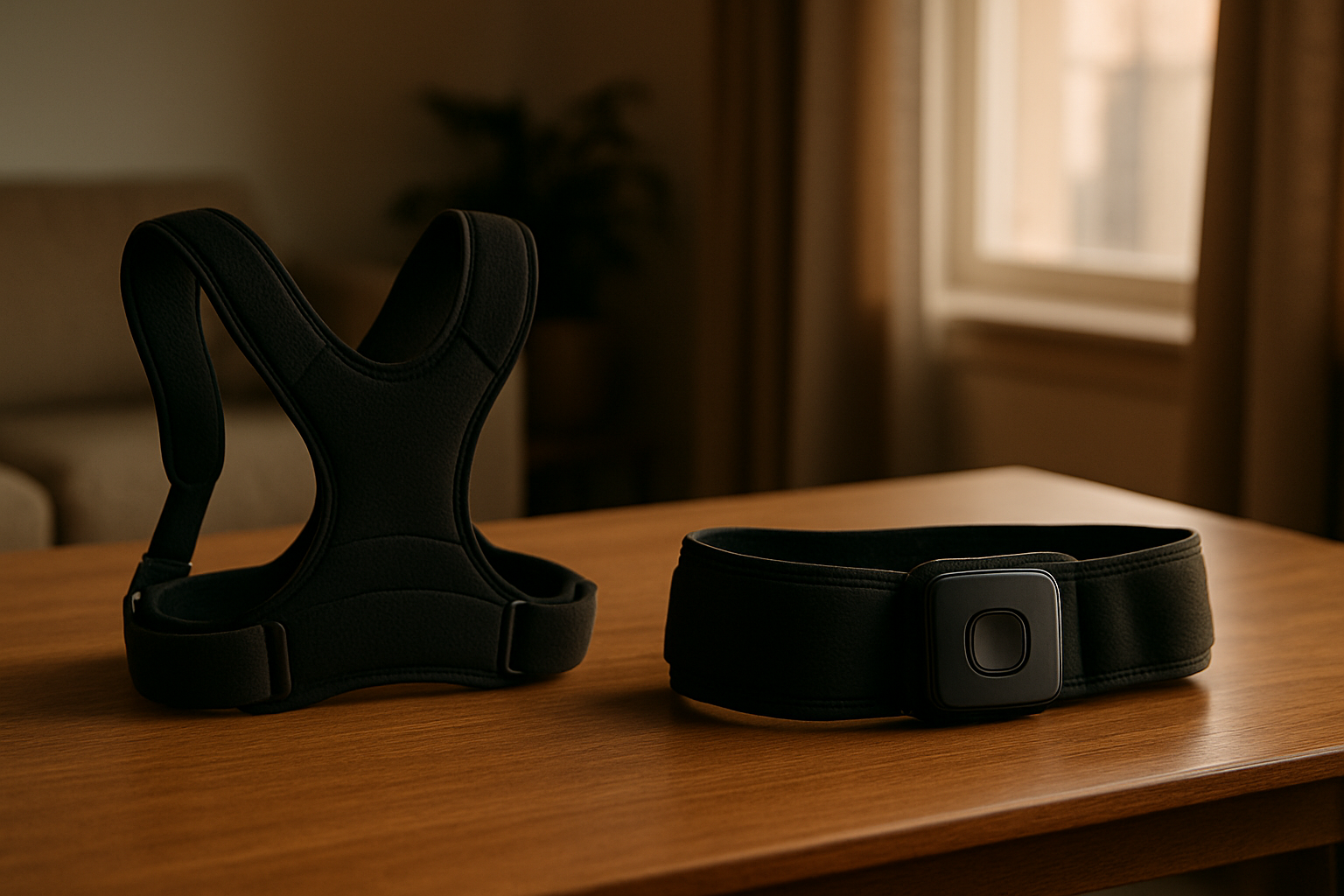
In the shop: Posture corrector — it reminds, it does not straighten and EMS abdominal belt — what it does, and what it does not.
The posture corrector: a reminder, not a treatment
Poor seated posture is almost never a willpower problem. It is a motor habit: the body adopts the position that costs least effort, and after a few months that is the one that feels comfortable.
A corrector acts on exactly that. By pulling the shoulders back, it makes slouching unpleasant before it settles in. The wearer straightens up not through discipline but because the low position becomes awkward — which is exactly what a reminder should do.
What it does not do, though, has to be said plainly: it strengthens nothing. The muscles that hold a posture — spinal erectors, rhomboids, mid-trapezius — are strengthened by work, not by wearing a strap.
Hence the most common and least known caveat: continuous wear. A back that rests on a strap all day works less than before, and weakens. The use that works is short and repeated, thirty minutes to an hour a day, long enough to reinstall the habit.
Electrical stimulation: what a triggered contraction actually does
An EMS belt sends a low-intensity current that triggers muscle contraction without the brain commanding it. The contraction is real, measurable, and the muscle responds to it as it would to effort.
Its serious uses are well documented: maintaining a muscle you cannot work voluntarily — after immobilisation, surgery or injury — and recovery at low frequency, where it supports circulation.
What it does not do is just as established. It does not remove abdominal fat. Fat burning is a general phenomenon governed by total energy expenditure and diet; no local contraction unloads the fat sitting above it. A belt can firm the muscle under the layer; it does not remove the layer.
And the contraindications are real, not decorative: pacemaker, pregnancy, metal implant in the area, epilepsy, sensory disorders. When in doubt, medical advice comes before purchase.
The headband, the item nobody discusses that changes a session
A set rarely ends because the muscle gives out. It ends far more often because you have wiped your forehead for the fourth time, or because sweat stings your eyes just as you need to hold the position.
A towelling headband improves no performance. It simply removes a cause of interruption — and over a thirty-minute session, that shows up in the number of reps actually completed.
The only thing to watch is care: wash at thirty degrees, dry flat. In a tumble dryer the elastic relaxes within a few cycles and the band slips, which makes it more of a nuisance than a help.
How to use them without the wrong expectation
The posture corrector: in short sessions, alongside upper-back strengthening. Alone and worn continuously, it wastes time.
The EMS belt: for maintenance, recovery or as a supplement — never instead of a session, and never with the idea of losing belly fat.
The headband: two in rotation, so one is always dry. It is the only item on this list whose effect is immediate and unqualified.
And the principle common to all three: a worn object never replaces a movement. It removes an obstacle, it recalls a position, it maintains a muscle — the work itself is still yours to do.
Frequently asked questions
Does a posture corrector straighten your back for good?
It does not straighten: it reminds. Lasting posture comes from strengthening the upper back muscles, which the corrector does not train. Its role is to reinstall the habit while that strengthening happens.
How long a day should you wear a posture corrector?
Thirty minutes to an hour, in one or two spells. Beyond that, the postural muscles rest on the strap and lose tone — the exact opposite of the intended effect.
Does an EMS belt burn belly fat?
No. It contracts the muscle sitting under the fat; it does not unload the fat covering it. Fat loss depends on total energy expenditure and diet, not on local stimulation.
Does electrical stimulation replace a workout?
No. It maintains a muscle you cannot otherwise work and helps recovery, but it loads neither the cardiovascular system nor coordination. It is a supplement, never a substitute.
Who should avoid electrical stimulation?
People with a pacemaker, pregnant women, anyone with a metal implant in the treated area, and in cases of epilepsy or sensory disorders. When in doubt, seek medical advice before use.
Do gel electrodes wear out?
Yes, they lose adhesion after a number of uses and get replaced. It is this kind of device's consumable, and it is better known before purchase than after.
Is a sports headband actually useful?
It improves no performance but removes a common cause of interruption: sweat in the eyes. Over a long session that translates into sets carried to the end instead of being cut short.
How do you wash a headband without ruining it?
At thirty degrees, dried flat. A tumble dryer relaxes the elastic within a few cycles: the band then starts to slip, which makes it unusable long before the fabric wears out.