Resistance bands or dumbbells: what each one actually does
One gives the same load from start to finish, the other a resistance that rises as it stretches. This is not about budget: they do not train the same point of the movement.
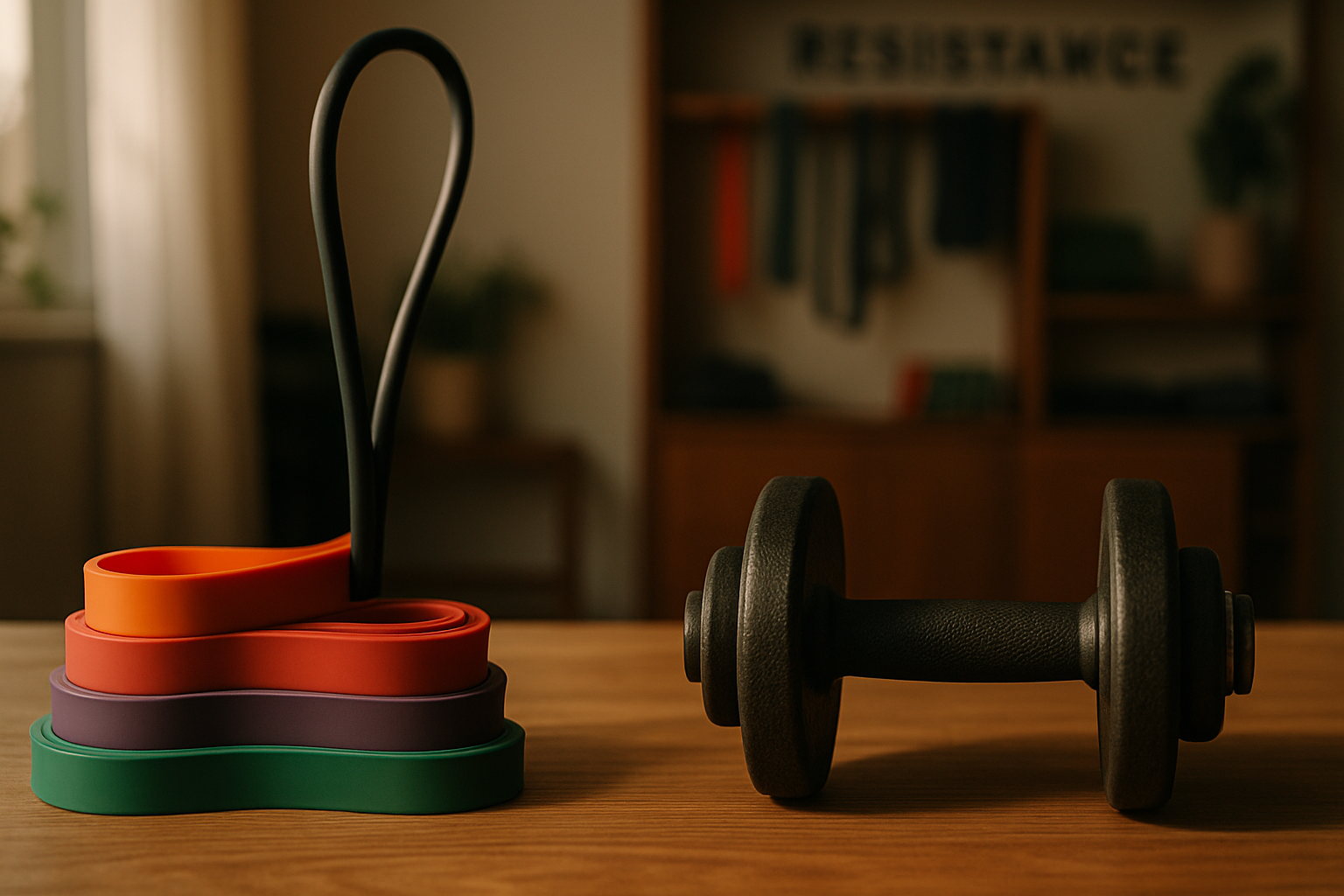
In three lines
Iron opposes a constant load; an elastic opposes a rising resistance, maximal at the end of the range.
So an elastic is good where the joint is stable and a classic load is uncomfortable: upper body, rehab, warm-up.
It does not replace a loaded barbell for maximal strength, and that is not a weakness of the kit: it is the resistance curve.
In the shop: Adjustable hand gripper — 10 to 60 kg on a dial and Fabric resistance bands — three levels, and they stay put.
Two resistance curves, two uses
When you lift ten kilos, you lift ten kilos from the first centimetre to the last. The perceived difficulty, though, varies: it peaks where the lever arm is least favourable, usually mid-movement, and drops at the top.
An elastic does exactly the opposite. Slack, it opposes almost nothing; stretched, it opposes a great deal. The hardest point therefore lands at the end of the range — where, on most movements, the joint is best locked and the muscle shortest.
That difference explains concrete things. An elastic curl burns at the finish and feels easy at the start; a dumbbell curl does the reverse. Neither curve is superior: they load different portions of the same contraction, and combining them beats choosing.
It also explains why elastics are the default tool in rehab. The load is light where the joint is vulnerable and heavy where it is stable — exactly the profile you want after an injury.
What an elastic does better, and what it will not do
It wins on training volume at home. A set of tubes weighs three hundred grams, fits in a drawer, and covers most of the upper body if you have an anchor. No iron setup competes on that ground.
It also wins on rotation and abduction movements, where iron can oppose no useful resistance because gravity pulls on the wrong axis. Shoulder rotations, hip abductions, glute work: the elastic is at home there.
It loses on maximal strength. Past a certain level you would have to stack so many tubes that the setup becomes unstable, and the resistance at the start of the range stays derisory. For pure strength, a free weight or a machine remains necessary.
It also loses on measurement. A '20 kg' band states a resistance reached at some stretch length, rarely specified. Two bands with the same label are not equivalent, and you cannot keep a training log as precise as with iron.
The anchor decides half the exercises
With no fixed point, an elastic only lets you push and spread. Everything that involves pulling towards yourself — rows, pulldowns, face pulls — needs an anchor.
A door anchor costs a few euros and literally doubles the exercises available. It goes on the hinge side, door shut: placed on the other side, pulling opens the door, and that is the one genuine cause of accidents with this kit.
Failing that, a heavy furniture leg, a post or a railing will do. What to avoid are points that can give way at once: a handle, a radiator, a chair leg.
Choose, and above all combine
For the lower body, fabric bands beat latex for one reason only: they do not ride up the thigh. An elastic that rolls on the third rep ends the set, whatever its resistance.
For the upper body, tubes with handles and a door anchor cover the widest range of movements for the least bulk.
For free weight at home, water-filled dumbbells solve storage and transport, at the price of a low ceiling: water weighs one kilo per litre, and no more.
The best use, in practice, is not to choose but to alternate. The same muscle trained under two different resistance curves progresses better than the same muscle trained twice the same way.
Frequently asked questions
Do resistance bands really build muscle?
Yes, as long as the resistance is enough to take the set close to failure. Muscle responds to tension and volume, not to the type of equipment. The limit arrives when the available resistance becomes too light for you.
What does the resistance in kilos printed on a band mean?
It is the force produced at a given stretch length, rarely specified by the maker. Two bands showing the same figure can therefore differ noticeably: the number compares bands within one set, not across brands.
Latex band or fabric band, which should you choose?
Fabric for the lower body, because it does not ride up the thigh. Latex for the upper body and long ranges, because it stretches far more. They do not replace each other.
Can you train with elastics alone?
For health, toning and maintenance, yes, provided you cover every muscle group and have an anchor. For maximal strength, no: sooner or later a free weight is needed.
Where can a door anchor be fixed safely?
On the hinge side, with the door shut and preferably locked. Fixed on the opening side, pulling forces the door. A heavy furniture leg or a post are safe alternatives.
How long does a resistance band last?
Several years in home use if stored away from light and heat, which degrade latex. A band that whitens, goes tacky or shows a micro-crack must be replaced: it snaps without warning.
Should you warm up before an elastic session?
Yes, as with any load. Elastics feel harmless at the start because the resistance is light there, but the tension at the end of the range is entirely real.
Are water-filled dumbbells as good as real iron?
For toning, rehab and travel they do the same job. For strength their ceiling is low: a litre of water weighs one kilo, and the available volume sets the limit.